Imposter Syndrome: The Ultimate Imposter in the Room?
Unmasking the illusion of inadequacy in a world hooked on performance and pretense.
[7 min read]
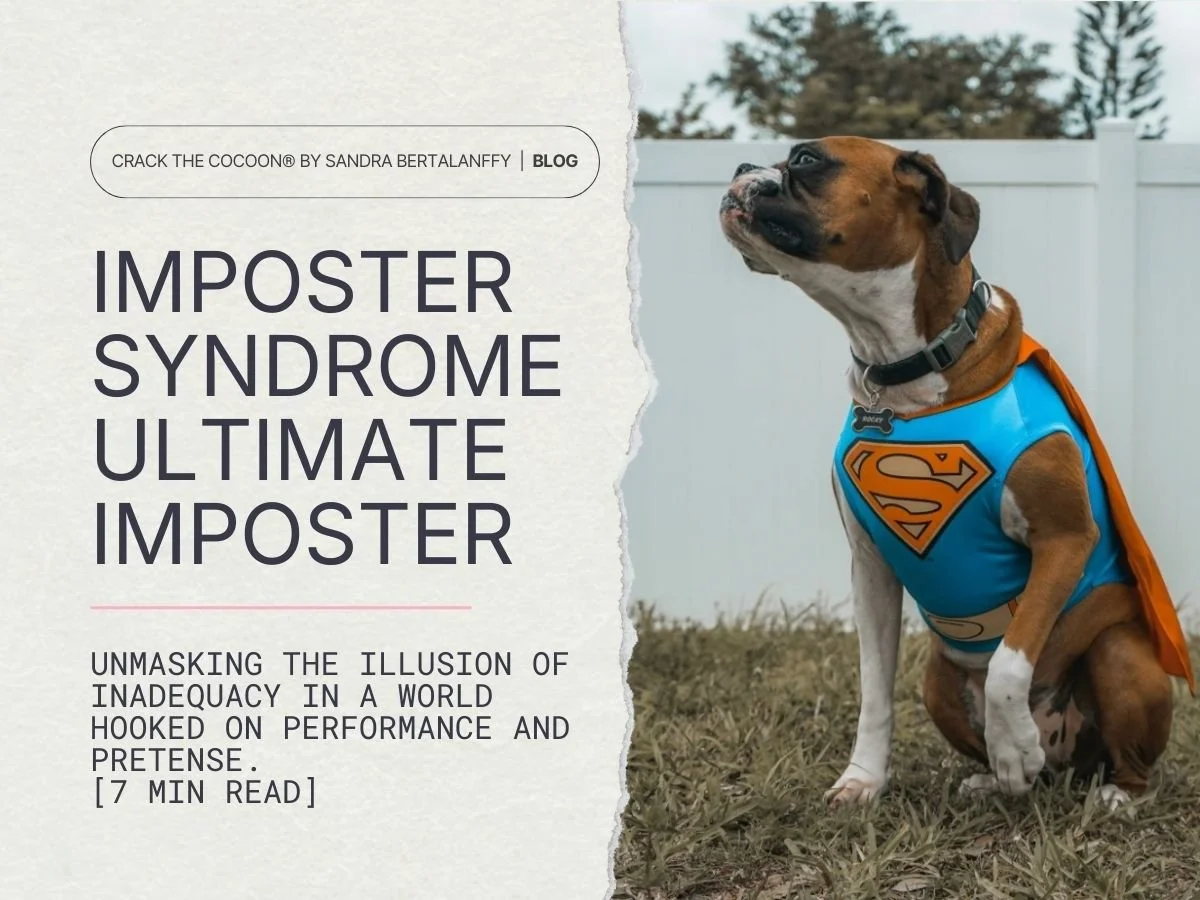
Abstract: This essay explores how what is commonly known as imposter syndrome is a mere distraction from recognizing the significance of your authentic self as it expresses from the core and how that in itself is the most purposeful contribution to human innovation.
When my clients approach me for Public Speaking Coaching, there are certain topics they usually want to talk about, like how to make a lasting impression or how to deal with stage fright. Recently though, I’ve been increasingly approached about this fashionable thing called “Imposter Syndrome.”
So here are my two cents on the topic.
What’s wrong with me?
Personally, I found my way into the whole imposter rhetoric a good while ago, through the gateway thought of: “What’s wrong with me?” It came about from feeling like I couldn’t do life as well as others — or at least as well as they appeared to be doing it — whilst in reality living my most extraordinary and courageous life hustling and bustling through the streets of New York City, chasing after my dream. Nonetheless, that nagging “What’s wrong with me?” led me inward for many years.
After about a decade in there, I’m resurfacing with the answer: “Nothing.” Turns out that I’m just doing life differently. My own unique way.
Was it a waste of time then, this decade of contemplation?
No. Like everything else on my extensive and colourful CV, it provided incredible experiences and a macroscopic perspective on the human nature, both my own and others’.
So I’m giving you my distilled perspective on this topic. It may sound simple, and I hope it does. As a matter of fact, rather than simple, I hope it provides something essential: Untangle, fly free and make the mark you’re meant to make.
So let’s jump in.
Imposter Syndrome - What is this thing?
It happens to the best of us. In fact, that’s the point — it only happens to the best of us, by definition. Because “Imposter Syndrome” — originally and more accurately called the “Imposter Phenomenon” — describes an inner experience of feeling like a fraud, despite objective success. Hence, high-achieving environments provide the perfect breeding ground.
Such mental delusion of inadequacy makes the so-called “imposter” continuously doubt if they are qualified enough for the job. They are in a constant fear of being unmasked, for example by being asked a question in an interview that would expose how little they actually knew about the topic or somehow reveal that they’re not the expert they claim to be. To cope, they over-prepare or exhibit other common perfectionist patterns. Even repeated success usually doesn’t break that mental cycle.
Hence the “impostor” begins to do everything possible to prevent being discovered in their self-perceived deficiencies.
This can have merciless consequences, like severe mental health challenges or quite simply prevent accomplished, highly skilled individuals from speaking up or stepping up, therefore manipulating themselves out of their own contributions. A devastating consequence for innovation.
So why would one have this experience of not having an internal sense of one’s own success - despite the accolades, despite any external factor clearly attesting to the opposite? And why is it important to speak up, step up and contribute?
Well, as we shall see, there are a handful nature/nurture variables that make it more likely for an individual to be susceptible to this inner experience. Also, a tendency for more courageous life choices, like any 180 degree lifestyle change, or swapping peer groups or upgrading ones socio-economic surrounding, can provide fertile soil for imposter feelings to grow. But overall, it is crucial to realize that behind this seemingly personal mind battle often lurk deeper, systemic issues. These issues sabotage proper integration of the “imposter” into a new surrounding and hence destroy the grounds and confidence to contribute.
The seeds of self-doubt - “imposter style”: Odd egg out.
Imposter feelings stem from a gap between our inner experience, how we present ourselves to the world and the feedback we receive in return.
We each have a true nature, which seeks to live in line with our own inner values, talents, and natural personality. This is our Authentic Self, our inner core. It expresses from the inside-out.
In contrast, there is our False Self, an inauthentic presentation of our being, which is pieced together by societal expectations and collective conditioning. You can think of this version as outside-in, external factors internalized to create a polished character.
The false self is like a mask to protect the more vulnerable parts of who we really are — especially in environments that don’t feel safe or supportive. Its purpose is to meet expectations and keep social harmony. (Hello, people pleasers.) But it’s just a performance. It hides our real thoughts and feelings in order to seemingly fit in.
The belief that we need to wear a mask to be accepted can stem from early family dynamics, where caretakers sent mixed messages about our capabilities. Maybe your sibling was always seen as “the smart one,” or maybe you were labeled “best at everything.” Either way, the inner conflict shows up later in life when those early roles clash with what the world reflects back: “I feel inadequate, yet others see me as capable,” or “I’m supposed to be exceptional, but I’m not recognized.”
For the “imposter” this inner battle most acutely shows up in adult life when crossing a social threshold — moving from one world into another. A new job, a different culture, a shift in socio-economic class. Suddenly, they’re in a space they are not sure they belong in and are forced to juggle two different realities. For example, the expert ex pat, the minority at the majority table, the first academic in the family. A triangle in a room full of squares.
The results of self-doubt - “imposter style”: Stalled innovation.
To feel like the odd egg out is a tricky situation to handle. Unfortunately it’s quite common to point the lens on the individual and label this occurrence a personal flaw. The individual buys into this faulty thinking and struggles. The environment offers surface-level fixes at best, like support groups, advancement rates or trainings, but this isn’t a “fixing feelings” situation nor a flaw of the individual. It’s about recognizing that exceptional people often land in environments that fail to see or integrate them — especially within the corporate cultures built on pressure, competition, and outdated norms.
This is problematic on an individual, on an organizational level and beyond. Highly skilled people are struggling on the inside, which means they’re either holding back their contributions or overextending themselves repeatedly to deliver - despite their immense inner struggle. As a result, some leave, some burn out, and others stay but gradually shut down parts of themselves just to fit in. Besides this being an unsustainable situation, it’s a missed opportunity for individual expression as well as a missed chance for the organization to adapt and grow. And in a world that’s changing fast, that’s a risk no one can afford to take.
The way out of imposter-thinking
Alrighty. We’ve gone around understanding what the Imposter Phenomenon is, why some folks may be more susceptible to it, where it may have started and why it’s to be taken so seriously. We’ve considered that it may not be a personal flaw, but rather an expression of an unadaptive system. Ok.
So, now what? Is it a thing then, or is it not? What to do with this imposter of a symptom?
Whether it’s a thing or not, is not the question. For the individual experiencing these feelings, it’s as real as it gets and the consequences reach far beyond individual struggle. Acknowledging that it may take some time to untangle from this identification, here’s something to consider in the meantime:
If you have previously self-diagnosed with imposter syndrome, can you reconsider? Can you consider yourself free from this? Can you move from “I am an imposter or I have self-doubt” to “I am experiencing self-doubt in this moment”?
Self-doubt is a normal feeling and when it comes around, don’t make it bigger than it is. Don’t buy into it. Consider it to be a temporary mental distraction and probably a sign that you’re on the right track. Get back to work. Focus on what it is you can and want to contribute.
And what is that? Well, remember your True Self? You inner core, which expresses naturally from the inside-out? This part knows what and how to contribute. It may be worth your time and effort to explore that part of yourself. Because the mask you’re wearing, your inauthentic self, is made up of information from your environment, hence it’s highly vulnerable to change and wildly unreliable. And just not you.
Everything is alright with me
Instead of asking “What’s wrong with me?”, consider asking: What part of me is performing right now - and what is it trying to prove? To whom? When you notice the performance, the aspect of self you’re masking, it’s a wonderful chance for you to return to yourself, to your core. When you do that, you begin to settle into your authenticity and with that you can start to make the mark you’re meant to make.
So, when my clients approach me for Public Speaking Coaching, and want to talk about making a lasting impression, overcoming stage fright or dealing this terrible imposter of all syndromes, I have great news. The solution is the same and that’s where we’ll start.
The art of it all is to allow yourself to get back in touch with your core and allow your true self to unfold naturally - from the inside-out. That’s the part you can count on, always and in any situation or setting. It’s the only thing you really have power over - plus, the ripple effects on your environment are tremendous and positive.
So, focus on what you truly want to say, not why you have trouble saying it or why “the environment” makes it hard for you to say. Untangle, fly free and make the mark you’re meant to make.
What is it you want to say?
.
I for one will say this:
“True confidence to contribute doesn’t arise in isolation, it grows in dynamic relationship with the environments we move through: our teams, our culture, or the stage. When these systems fail to recognize individual potential and expression, pressure to perform often turns into imposter feelings. But imposter syndrome isn’t a personal flaw, it’s adaptive feedback from the system. A sign that the environment hasn’t yet evolved to perceive and integrate certain forms of excellence. Transformation begins when we stop pathologizing our most unique, brilliant and courageous individuals, and start reshaping our environments in mutual recognition — through intentional inquiry and courageous leadership. Not by pushing to belong or being pressured to conform, but by centering back into our natural selves. True innovation begins when people freely offer what’s truly theirs, and the whole environment strengthens by receiving it. Embracing this is essential for growth, evolution, and survival of the human species.”
- Sandra Bertalanffy, Founder Crack the Cocoon®
Subscribe to Crack the Cocoon® by Sandra Bertalanffy— for a fresh perspective in your inbox.
PS. For the thinkers and researchers.
References
Ann White Group. (2024). Imposter syndrome among women executives can lead to self-doubt, reluctance to pursue promotions, and decreased job satisfaction. Retrieved from https://annwhitegroup.com
Baldwin, J. (1966, July 11). A report from occupied territory. The Nation. https://www.thenation.com/article/archive/report-occupied-territory/
Bertalanffy, L. von. (1968). General System Theory: Foundations, Development, Applications. George Braziller.
Bourdieu, P. (1977). Outline of a Theory of Practice. Cambridge University Press.
Brown, B., Burey, J.-A., & Malhotra, R. T. (2021). Imposter syndrome [Podcast episode]. Dare to Lead Podcast. https://brenebrown.com/podcast/imposter-syndrome/
Burey, J. A. (2021, March). The myth of bringing your full, authentic self to work [Video]. TEDxSeattle. https://www.ted.com/talks/jodi_ann_burey_the_myth_of_bringing_your_full_authentic_self_to_work
Clance, P. R. (1985). The impostor phenomenon: Overcoming the fear that haunts your success.Peachtree Publishers.
Clance, P. R., & Imes, S. A. (1978). The impostor phenomenon in high achieving women: Dynamics and therapeutic intervention. Psychotherapy: Theory, Research & Practice, 15(3), 241–247. https://doi.org/10.1037/h0086006
Clance, P. R., & O’Toole, M. A. (1987). The impostor phenomenon: An internal barrier to empowerment and achievement. Women & Therapy, 6(3), 51–64. https://doi.org/10.1300/J015V06N03_05
Cuddy, A. J. C., Fiske, S. T., & Glick, P. (2008). Warmth and competence as universal dimensions of social perception: The stereotype content model and beyond. Advances in Experimental Social Psychology, 40, 61–149. https://doi.org/10.1016/S0065-2601(07)00002-0
Crawford, W. S., Shanine, K. K., Whitman, M. V., & Kacmar, K. M. (2016). Examining the impostor phenomenon and work–family conflict. Journal of Managerial Psychology, 31(2), 375–390. https://doi.org/10.1108/JMP-12-2013-0409
Hope, D. (2010, January 24). Before you diagnose yourself with depression or low self-esteem, first make sure that you are not, in fact, just surrounded by assholes [Tweet]. Twitter. Retrieved from https://web.archive.org/web/20160316000000*/ https://twitter.com/debihope/status/8258268846
Jamison, L. (2023, February 6). Why everyone feels like they’re faking it. The New Yorker. https://www.newyorker.com/magazine/2023/02/13/the-dubious-rise-of-impostor-syndrome
KPMG. (2020). Advancing the future of women in business: A KPMG women’s leadership study. https://assets.kpmg/content/dam/kpmg/xx/pdf/2022/12/mind-the-gap.pdf
Liu, J. (2022). The truth behind imposter syndrome. Harvard Business Review. https://hbr.org/2022/08/christine-vs-work-the-truth-behind-imposter-syndrome
Paulise, L. (2023, March 8). 75% of women executives experience imposter syndrome in the workplace. Forbes. https://www.forbes.com/sites/lucianapaulise/2023/03/08/75-of-women-executives-experience-imposter-syndrome-in-the-workplace/
Riggio, R. E. (2025, January). Why you may feel like an imposter and why you shouldn’t. Psychology Today. https://www.psychologytoday.com/gb/blog/cutting-edge-leadership/202501/why-you-may-feel-like-an-imposter-and-why-you-shouldnt
Roberts, N. F. (2023, September 27). Imposter syndrome and the psychology of doubt: Fact versus fiction. Forbes. https://www.forbes.com/sites/nicoleroberts/2023/09/27/imposter-syndrome-and-the-psychology-of-doubt-fact-versus-fiction/
Tulshyan, R., & Burey, J. A. (2021, February). Stop telling women they have imposter syndrome. Harvard Business Review. https://hbr.org/2021/02/stop-telling-women-they-have-imposter-syndrome
Winnicott, D. W. (2024). Animal Joy. London: Routledge.
Young, V. (2011). The secret thoughts of successful women: Why capable people suffer from the impostor syndrome and how to thrive in spite of it. Crown Business.